

The Threshold Knows First
Long before you turn the key, your home has already said something to you. On doorsteps, what they tell us, and a four-second practice for coming home on purpose.

Long before you turn the key, your home has already said something to you. Most of us are too busy looking for our keys to hear it.
I have stood on a great many doorsteps. Some were swept to within an inch of their lives. Some had a bicycle leaning against the wall that had clearly been leaning there since the spring before last. One had a small ceramic hare tucked beside the boot scraper, facing the street like a sentry. Every one of them told me something true about the woman who lived inside, and usually something she had not yet said out loud.
The threshold is where the outside world ends and your world begins. It is the first room of the house, even though it has no walls.
What the threshold is for
In almost every old tradition I know, the threshold was treated with care. Brides were carried over it. Salt, iron or rowan were placed near it. People stepped over it with the right foot first, or knocked on the frame before entering a stranger's home. We tend to smile at these customs now, as if our great-grandmothers were simply superstitious.
I think they were paying attention.
A threshold is a place of transition, and transitions are where we are most open. You carry the day in with you: the argument on the tram, the email you have not answered, the weather. What happens at your door decides how much of that comes inside and how much is left on the mat.
Reading your own doorstep
Go outside. Close the door behind you. Stand where a visitor would stand and look, properly, as if you had never been here before. You might feel a little foolish. Lenisa certainly thinks I am foolish when I do this, and she makes her feelings known by sitting on my feet.
Then ask yourself a few gentle questions:
- What is the first thing your eye lands on? Is it something you chose, or something you stopped seeing years ago?
- Is the way in obvious and easy, or does a visitor have to guess, squeeze or step around something?
- Is there any light here after dark?
- If this doorstep were a sentence about you, what would it say?
There are no wrong answers. There is only what is there.
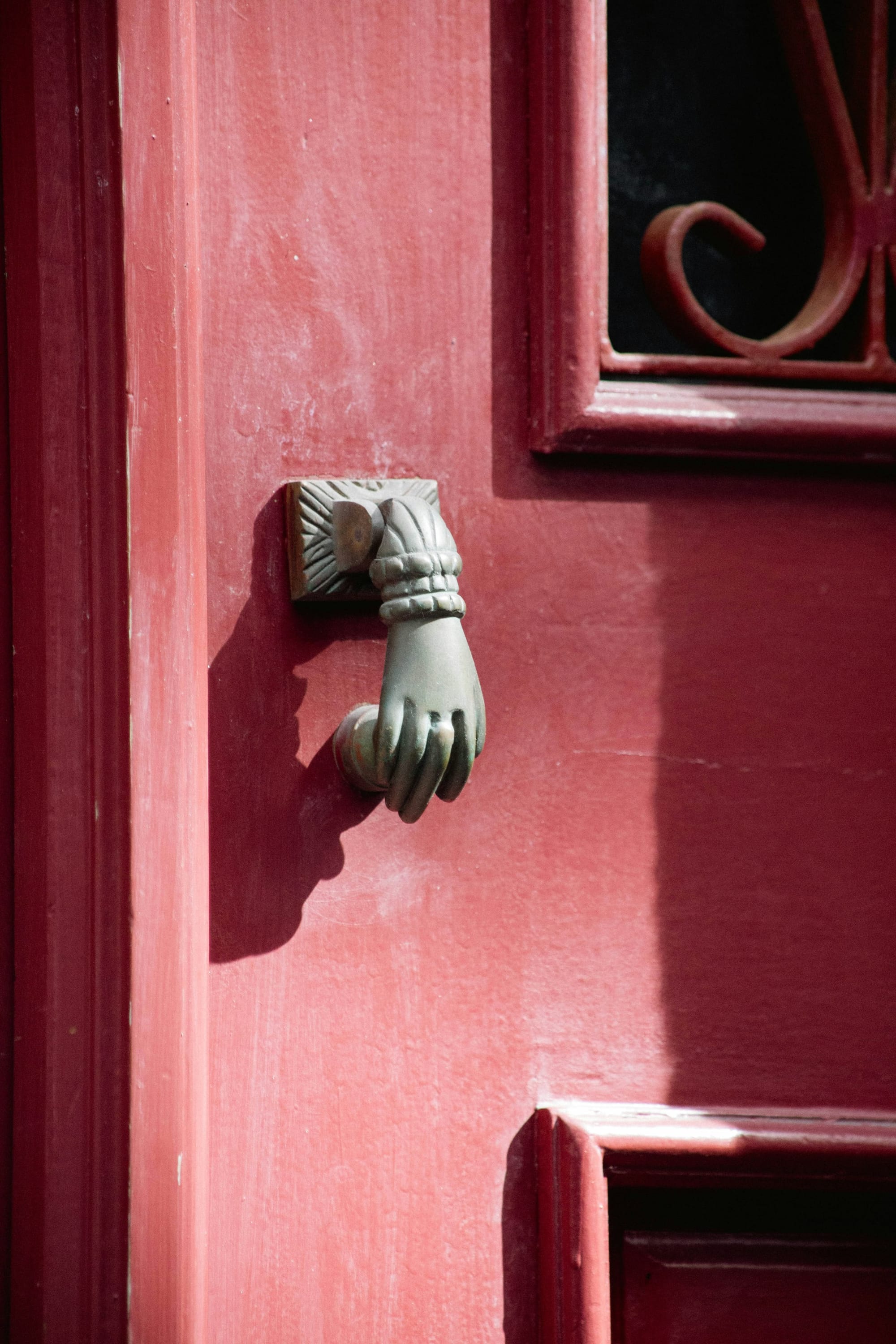
The stories doorsteps tell
A cluttered threshold often belongs to a woman who is holding a great deal at once, and who has stopped expecting anyone to arrive. A spotless, bare threshold can belong to someone who keeps the world at a very polite distance. A broken light by the door is often the outer sign of an inner reluctance to be found, or to come home at all.
The threshold does not judge you. It simply reports.
I once visited a house where the front door had not been used in four years. Everyone, including the owner, came and went through the side door by the bins. When we talked about it, she laughed and said it was simply more practical. Then she was quiet for a while and said that the front door had been the door her husband used, and after he left she had not wanted to walk through it. The house had been keeping that secret on her behalf.
We did not rearrange a single thing that day. She simply started using the front door again. A month later she wrote to tell me she had bought a new doormat, a ridiculous one with a hedgehog on it, and that she liked coming home.
A small threshold practice
You do not need to repaint your door or buy anything at all. Try this for a week instead.
Each time you arrive home, pause for one breath on the doorstep before you go in. Put your hand flat on the door or the frame. Notice what you are carrying. Then decide, deliberately, what you are bringing inside with you.
That is all. It takes perhaps four seconds. It is the oldest kind of magick I know: attention, placed on purpose, at the edge of things.
If you want to go further, give your threshold one thing that is purely for you. A pot of rosemary. A stone from a beach you loved. A lantern. Something that says, every time you see it, you live here, and you are expected.
Before you step inside
This is the first room of a much longer conversation about homeing, the living art of making a home that can hold who you actually are. We will walk through the rest of the house together, room by room, in time.
But start here, on the step. Your home has been talking to you for a while. It is a good moment to answer.